281 Oriental Shorthair Colors
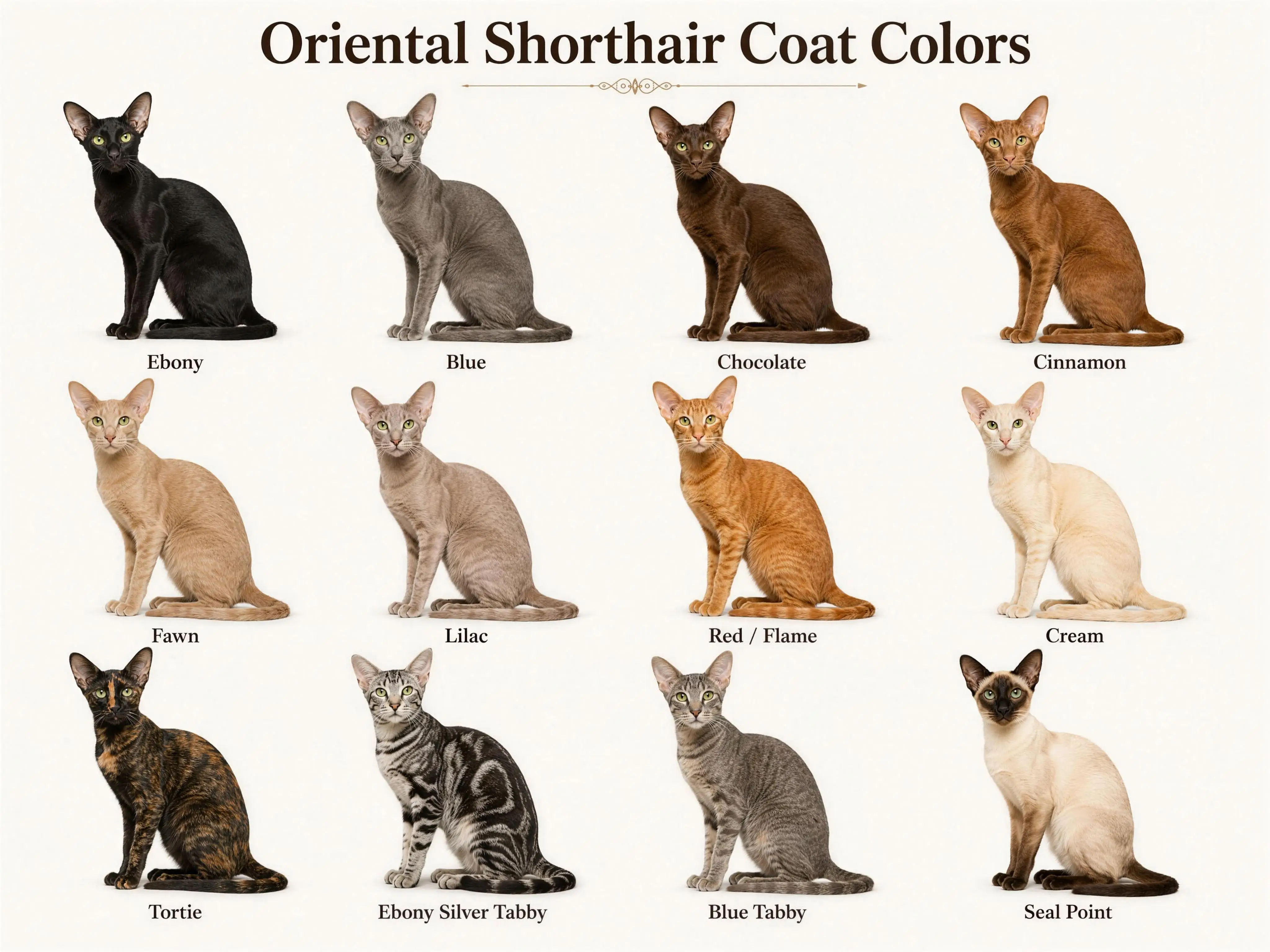
The Oriental Shorthair holds the record for the most recognized color and pattern combinations of any cat breed — 281 documented variations under the TICA breed standard. This is no exaggeration; it's the deliberate result of 80 years of breeders refusing to limit Orientals to a single "look." This page walks through every major category — solid, tabby, smoke, shaded, particolor, tortoiseshell — and explains why each one exists.
On This Page
Solid Colors (the 11 Base Colors)
Solid coats are the most common starting point — a single uniform color across the entire body. Royal Oriental works with all 11 TICA-recognized solid colors: Ebony (black), Blue, Chocolate, Lavender, Red, Cream, Cinnamon, Fawn, Caramel, Apricot, and White. Ebony is the most iconic; Cinnamon, Fawn, Caramel and Apricot are the rare, breeder-prized modifiers. Every one of these carries the same green-eyed, sleek Oriental look — only the coat changes.
Tabby Patterns
Tabby is the original cat pattern — found on wild ancestors going back 10,000+ years. Oriental Shorthairs come in four distinct tabby variations, each multiplied across all 11 base colors.
Classic Tabby: Bold swirled "bullseye" pattern on the flanks, often with a butterfly mark on the shoulders. Most dramatic of the four tabby types.
Mackerel Tabby: Narrow vertical stripes running down the body — like a fish skeleton. The most common tabby pattern globally.
Spotted Tabby: Discrete round or oval spots across the body. Visually similar to wild cats — Bengals, Ocelots, Egyptian Maus.
Ticked Tabby: No stripes or spots — each individual hair is "ticked" with bands of color (called agouti). Looks almost solid from a distance but reveals subtle patterning up close.
Smoke & Shaded
These categories involve a silver-white undercoat with the color visible only on the top portion of each hair. The visual effect is striking — the cat appears to "shimmer" as it moves.
Smoke: ~50% of each hair is colored, ~50% is silver-white. Most of the body looks the base color, but parting the fur reveals the silver underneath.
Shaded: Only the top 1/4 to 1/3 of each hair is colored — the rest is silver. Lighter visual effect than smoke.
Chinchilla / Tipped: Only the very tip of each hair has color, perhaps 1/8 of the total length. Most subtle silver pattern.
Tortoiseshell (Tortie)
Tortoiseshell patterns combine two colors in a marbled or patched layout — typically black and red, or their dilutes (blue and cream). Almost always female because the genetics requires two X chromosomes — male torties exist but are extremely rare genetic anomalies (XXY).
Royal Oriental's December 2025 litter includes ORI A3 — Tortie Female — a textbook tortoiseshell pattern. Tortie kittens are particularly prized in Oriental Shorthair lines because the female color complexity creates visually unique kittens.
Common tortie variations: Black Tortie (black + red), Blue-Cream (blue + cream), Chocolate Tortie (chocolate + red), Lavender-Cream (lavender + cream). Add tabby pattern and you get "Torbie" — tortoiseshell tabby. Add white and you get "Calico" — tricolor.
Particolor / Bicolor
A particolor or bicolor Oriental has distinct white patches alongside their main color. The white is typically on the belly, chest, paws, and face. TICA recognizes three particolor levels:
Mitted (low white): White only on paws ("mittens") and chin. Body remains 90%+ colored.
Bicolor (medium white): Roughly 50/50 white and color. Most balanced and visually striking distribution.
Van Pattern (high white): 90%+ white, color limited to head and tail. Named after the Turkish Van breed where it was first standardized.
Rarest Colors in the Oriental Breed
A few colors and combinations are exceptionally rare and command premium pricing globally:
Caramel + Apricot: Modifier colors — they require the rare "Dilute Modifier" gene. Most cat lines simply don't carry it. A Caramel Oriental can fetch 2-3× normal price internationally.
Cinnamon and Fawn: Cinnamon requires the b1 gene (recessive). Both parents must carry it for any kitten to be cinnamon. Fawn is dilute cinnamon — even rarer.
Ticked Tortoiseshell: Combines ticked agouti pattern with tortoiseshell color distribution. Visually extraordinary, genetically uncommon.
Black Smoke with Green Eyes: The contrast is dramatic — many silver/smoke Orientals have blue or odd eyes. Green eyes on black smoke is breeder-prized.
Royal Oriental Color Availability
At Royal Oriental, we work toward maintaining all 11 base colors in our breeding program — not just the easy ones. Our December 2025 litter shows three of those colors live and available:
ORI A1 — Chocolate Male: A textbook warm milk-chocolate solid. Bright green eyes. Sweet, affectionate personality.
ORI A2 — Black (Ebony) Male: Pure jet black solid. Green eyes. Playful and social.
ORI A3 — Tortie Female: Black-and-red tortoiseshell. Sociable and relaxed.
All three are $4,500 flat — no color premium, no surcharges for rare colors. We charge by Royal Oriental quality standard, not by the rarity of the color. Future litters will introduce additional rare colors (Lavender, Caramel, Ticked Tabby variants).
Reserve a Royal Oriental Kitten
$4,500 flat — all 281 colors, no surcharges. 50% non-refundable deposit reserves your kitten. Champion bloodlines, TICA registered, DNA-tested.
Apply Now Call (443) 540-7982